Awesome Stories
Upcoming Events


Kagadi District, 24 August 2026 — Farmers and cooperative leaders from Kyenjojo, Kagadi and Kikuube districts have been equipped with information on accessing the Government of Uganda’s Agricultural Credit Facility (ACF) and Small Business Fund (SBF), in a strategic effort to expand access to affordable finance for agricultural production and small businesses in the Bunyoro sub-region.
The sensitisation workshop, held in Kagadi District, was organised by the Bank of Uganda (BOU) in partnership with Uganda Cooperative Alliance Ltd (UCA), with representatives from commercial banks operating in the region participating in the engagement.
The initiative is part of broader efforts to ensure that farmers, cooperatives and small businesses are better positioned to take advantage of Government financing programmes designed to stimulate production, enterprise development and inclusive economic growth.
Officials from Bank of Uganda explained that the ACF and SBF are Government of Uganda financing initiatives implemented through BOU, with farmers and small and medium enterprises able to access the funds through participating commercial banks.
For UCA, the engagement goes beyond simply informing farmers about available financing. It reflects the Alliance’s growing strategic role in bridging the gap between Government financing programmes and the cooperatives and communities that are expected to benefit from them.
UCA was invited by Bank of Uganda to mobilise and guide farmers and cooperatives on the eligibility requirements, application procedures and responsible utilisation of the facilities.
Commercial bank representatives attending the workshop assured participants of technical support throughout the application process and encouraged farmers and cooperatives to engage their nearest bank branches. Participants were guided on the importance of having the required documentation, including cooperative registration certificates, business plans and collateral, as stipulated under the respective ACF and SBF guidelines.
Representing UCA, Hon. Bintu Jalia, Supervisory Board Member, emphasised that the intervention forms part of UCA’s wider commitment to ensuring that cooperatives across Uganda are able to access and effectively utilise Government programmes.
“Our role is to make sure that farmers and cooperatives are not left behind. We shall continue with financial literacy, imparting leadership and governance skills and group management training so that members can qualify and use these funds productively.”

UCA Strengthens Advocacy Capacity at Regional Cooperative Lobbying Training in Addis Ababa, Ethiopia

Mr. Nyabutundu (in the middle), during the training alongside other advocacy managers across Africa.
Addis Ababa, Ethiopia | 27th July 2026
The Uganda Cooperative Alliance (UCA) has reaffirmed its commitment to strengthening the voice of cooperatives by participating in a two-day Regional Capacity Building Programme on Cooperative Lobbying, Advocacy and Strengthening the Cooperative Enabling Environment, taking place in Addis Ababa, Ethiopia, from 27th to 28th July 2026.
Organized by the International Cooperative Alliance – Africa (ICA-Africa) under the ICA-EU Framework Partnership, the training has brought together cooperative leaders and managers from across the continent to strengthen their capacity to influence policies, shape legislation, and advocate for an enabling environment that supports the growth and sustainability of cooperative enterprises.
The programme seeks to equip participants with practical knowledge and skills for designing and implementing effective lobbying and advocacy initiatives within their cooperative institutions. The training comes at a time when the need for strategic lobbying and advocacy continues to grow as cooperatives navigate an increasingly dynamic economic, social, and regulatory environment.
Representing the Uganda Cooperative Alliance at the regional forum is Mr. Wilson Nyabutundu, UCA's Advocacy and Programmes Manager, who is participating alongside fellow ICA-Africa member representatives from Uganda, Kenya, Tanzania, Botswana, South Africa, Liberia, Ghana, Nigeria, and Ethiopia, the host country. The diversity of participants provides an important platform for peer learning, knowledge exchange, and the sharing of best practices in advancing cooperative interests across Africa.
Speaking from Addis Ababa, Mr. Nyabutundu noted that effective advocacy is fundamental to ensuring cooperatives remain influential partners in national and regional development. He emphasized that as the policy and regulatory landscape continues to evolve, cooperative institutions must be equipped to engage governments, legislators, development partners, and other key stakeholders in promoting policies that safeguard and advance the interests of cooperative members.
Participation in the regional training aligns with UCA's strategic objective of strengthening the cooperative movement through evidence-based advocacy, policy engagement, and institutional capacity development. The knowledge and practical skills gained from the programme will further enhance UCA's efforts to champion policies that promote a vibrant, competitive, and resilient cooperative sector in Uganda.
The regional programme also provides an opportunity for member organizations to deepen collaboration within the African cooperative movement, exchange experiences, and develop practical advocacy strategies that respond to emerging challenges and opportunities facing cooperatives across the continent.
As UCA continues to position cooperatives at the center of Uganda's socio-economic transformation, the Alliance remains committed to building the capacity of cooperative leaders and professionals to effectively influence policy, strengthen stakeholder engagement, and advocate for a more supportive business and regulatory environment.
Ends


Kyankwanzi, Uganda - The Uganda Cooperative Savings and Credit Union (UCSCU) is this week hosting the 1st SACCOs Leadership Summit at the National Leadership Institute (NALI), Kyankwanzi, bringing together more than 200 SACCO leaders and managers from across the country for a week-long engagement on strengthening the cooperative financial sector.
The summit, which commenced on Monday, is providing a platform for leaders to reflect on the role of Savings and Credit Cooperative Societies (SACCOs) in advancing Uganda's socio-economic transformation and contributing to the Government's Tenfold Growth Strategy. Participants are exploring practical approaches to enhancing SACCO performance, expanding financial inclusion, and positioning cooperatives as key drivers of wealth creation and national development.
Representing the Uganda Cooperative Alliance (UCA), Mr. Ivan Asiimwe, the General Secretary delivered a presentation on "Advocacy and Opportunities for Cooperation," highlighting the importance of strategic positioning to enable SACCOs to leverage emerging opportunities within Uganda's financial ecosystem.
The General Secretary encouraged SACCOs to strengthen their engagement with key institutions and programmes, including the Bank of Uganda (BoU), the Microfinance Support Centre (MSC), the Parish Development Model/Parish Revolving Fund initiatives, and the Uganda Development Bank (UDB), among others. He noted that proactive collaboration with these institutions would enhance access to financing, capacity building, and other growth opportunities for SACCOs.
He also shared updates on the Farmers' Organisations for Rural Transformation (FORT) Project, implemented by UCA, which is strengthening and empowering Smallholder Farmers (SHFs) across the country. The project presents a significant opportunity for SACCOs to expand their membership base by integrating organised farmer groups into the cooperative financial system, thereby increasing access to affordable financial services while promoting inclusive rural development.
In his closing remarks, the General Secretary urged SACCO leaders to remain steadfast in upholding cooperative values by placing members at the centre of their operations and ensuring transparency, accountability, and sound governance in the management of their institutions.
The week-long summit continues with a series of presentations, discussions, and experience-sharing sessions aimed at equipping SACCO leaders with the knowledge and strategies needed to build resilient, sustainable, and member-focused financial cooperatives that contribute meaningfully to Uganda's economic transformation.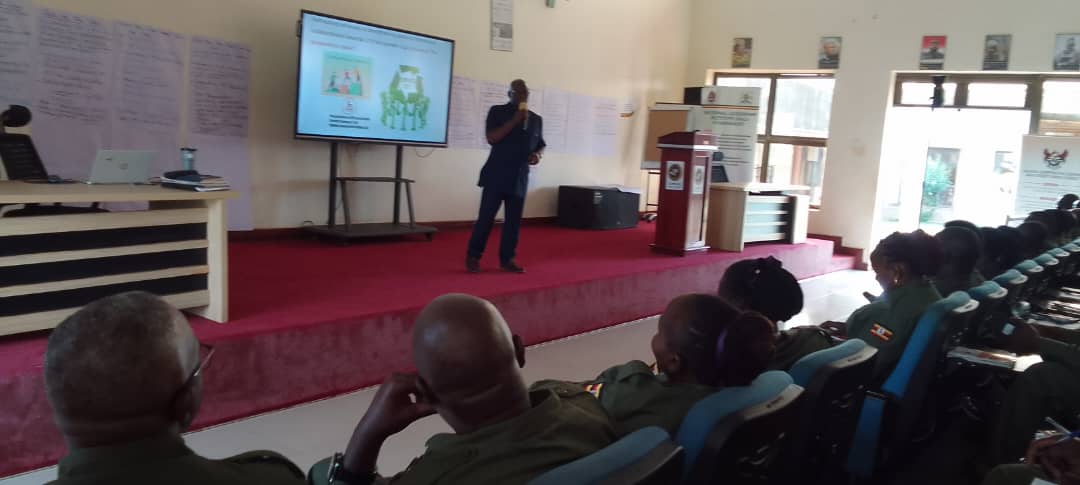
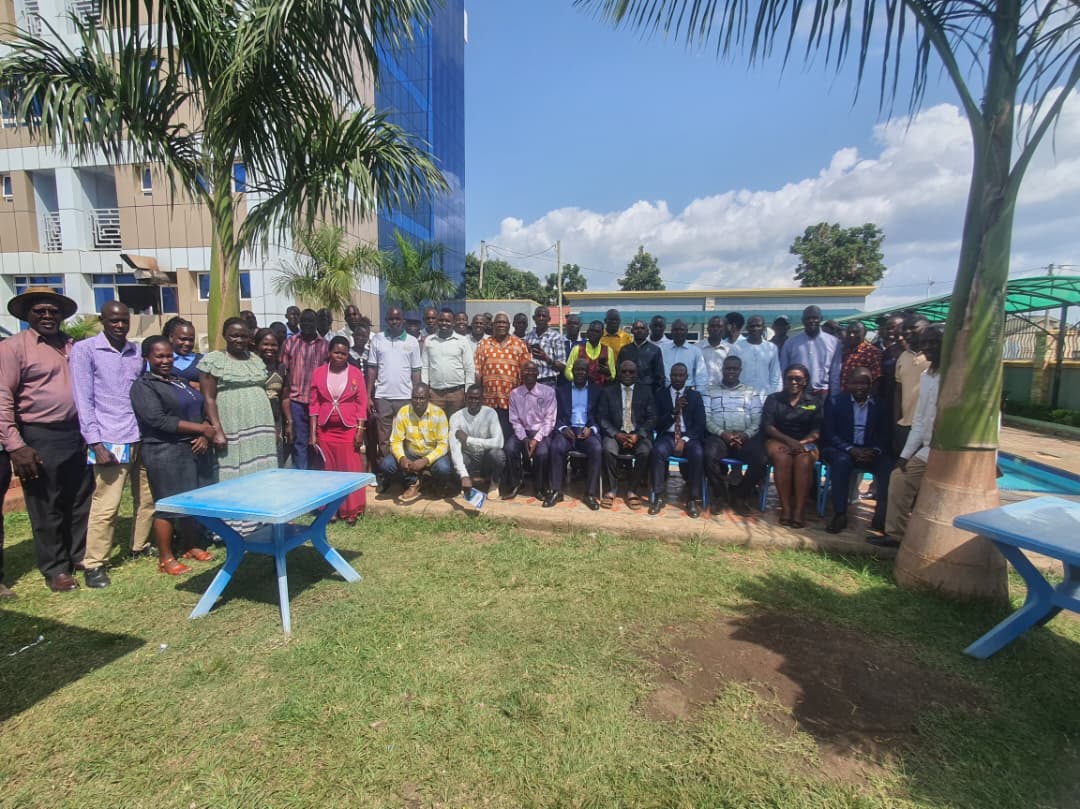
Gulu and Lira, Northern Uganda | 13–14 July 2026
The Farmers' Organisations for Rural Transformation (FORT) Project has taken another significant step towards strengthening farmer-owned enterprises by facilitating strategic business linkages between cooperatives and key service providers across Northern Uganda.
From 13–14 July 2026, the Uganda Cooperative Alliance (UCA), in partnership with Agriterra and with support from the Embassy of the Kingdom of the Netherlands and Wageningen University & Research, convened a regional business linkage forum that brought together farmer cooperatives, financial institutions, input suppliers, processors, off-takers, development partners and other key actors within the agricultural value chain.
The engagement focused on cooperatives operating in the maize, oilseed, cassava and honey value chains, providing a platform for them to establish partnerships that will enhance access to reliable markets, affordable financial services, quality agricultural inputs, technical support and other business development services essential for sustainable growth.
The initiative forms part of the FORT Project's broader objective of transforming farmer organisations into resilient, market-oriented and professionally managed enterprises capable of creating wealth for their members while contributing to Uganda's agricultural transformation agenda.
Speaking during the engagement, the General Secretary of the Uganda Cooperative Alliance, Mr. Ivan Asiimwe, challenged cooperative leaders to move beyond routine operations and deliberately position their organisations as competitive business enterprises.
"Opportunities do not wait for those who are asleep. Cooperatives must remain awake, proactive and ready to seize every opportunity that comes their way. The business environment is constantly changing, and only organisations that innovate, build partnerships and make timely decisions will remain competitive."
Mr. Asiimwe emphasised that cooperative leaders should not wait for development partners or government to solve every challenge facing their organisations. Instead, they should continuously seek partnerships, improve governance, strengthen member participation and embrace innovation as the foundation for long-term sustainability.
He further noted that business linkage forums provide an important opportunity for cooperatives to expand their networks and access services that would otherwise be difficult to obtain individually.
"The cooperative model gives farmers collective strength. When cooperatives build strategic partnerships with financial institutions, buyers, processors and technical service providers, they become stronger businesses that are able to create lasting value for their members. We must therefore remain alert, prepared and intentional in pursuing these opportunities."
Throughout the two-day engagement, participating cooperatives held business-to-business discussions with potential partners, explored financing opportunities, negotiated market arrangements and shared experiences on strengthening value chains. The interactions created a platform for practical collaboration aimed at improving production, value addition, aggregation, market competitiveness and income generation for cooperative members.
Participants also appreciated the opportunity to directly engage with institutions offering financial products, agricultural technologies and market solutions tailored to the needs of farmer organisations. Many described the forum as a timely intervention that bridges the gap between producers and the wider agricultural ecosystem, enabling cooperatives to build stronger commercial relationships and improve their competitiveness.
The business linkage initiative reaffirmed the importance of partnerships in strengthening Uganda's cooperative movement. By connecting farmer organisations with critical business services, the FORT Project continues to support the development of resilient cooperatives that are better equipped to respond to market demands, improve livelihoods and contribute to inclusive rural economic transformation.
As implementation of the FORT Project continues across its target districts, UCA and its partners remain committed to empowering farmer organisations with the knowledge, networks and business opportunities they need to thrive in an increasingly competitive agricultural sector.


Kampala, 10th July 2026 , members of the Board of Franciscan Investment Cooperative Society Ltd converged at The Great Outdoors, Kalanamu in Gayaza for a strategic Board Orientation facilitated by the General Secretary of the Uganda Cooperative Alliance Ltd [UCA].
He was joined by the UCA Technical Team and Ms. Sharon Nahabwe from CIC Insurance in an engagement designed to equip cooperative leaders with the knowledge, values and tools needed to drive sustainable growth.
The orientation placed strong emphasis on building strategic leadership. The Board was taken through the history and principles of cooperatives and the unique cooperative business model that puts members at the center of ownership and decision making. There was also a deliberate focus on leadership and governance structures, with clarity on the distinct roles of the Board, Supervisory and Vetting committees and Management. The message was clear: the Board sets policy and provides direction, while Management handles day-to-day operations.
The session further addressed risk management, the legal framework and policies that guide cooperative operations. Participants were reminded that compliance and good governance are the foundation for protecting member assets and building public trust.
A significant portion of the training was dedicated to resource mobilization and capitalization. The Board explored practical strategies for increasing member shares and savings, and for deepening participation in the ongoing capitalization drive for the National Savings and Credit Cooperative Society Ltd [NASACCO]. This was presented as a critical step toward ensuring that cooperatives own and control their financial institutions.
To reinforce the key messages, the General Secretary drew on powerful stories that resonate with cooperative values. Through the Eagle analogy, the Board reflected on vision, renewal, opportunities in challenges and resilience. The story of Lakita highlighted the power of unity, strategic planning and collective responsibility. Teachings from Prof. Lumumba provided lessons on African leadership, integrity and self-determination. These were presented as the pillars upon which the SACCO Board must build to drive growth, strengthen unity, and provide strategic leadership.
The engagement is expected to yield tangible results for Franciscan Investment SACCO. The Board will be better positioned to provide strategic governance through clear policy direction and long-term planning. It will also have improved oversight capacity to manage risks, ensure compliance, and safeguard member assets. Through deliberate action, the SACCO should see increased resource mobilization in terms of member shares and savings. The training also sets the stage for financial sustainability through stronger policies on credit, investments and growth, and ultimately enhanced service delivery anchored in transparency, accountability and member value.
“This engagement is in line with our mandate as UCA. I am on the move to fulfill it by equipping cooperative leaders with knowledge, values, and tools for sustainable growth and resource mobilization,” said the General Secretary of UCA.
UCA continues to roll out capacity building programs for SACCOs across the country. The objective remains to ensure sound governance, increased resource mobilization, and improved service delivery for members.



On July 08, 2026, The General Secretary of UCA attended a Sacco Board Orientation Retreat for Walimu Cooperative Union held at Les Foyers de Charité in Namugongo.The G.S was invited to facilitate the incoming board members with a session centered on the Cooperative Model.
The training put strong emphasis on Cooperative Principles and practical ways to strengthen governance so that the Sacco can grow and position itself as No. 1 in the sector.
To drive the message home, two powerful illustrations were used: the Eagle analogy and the story of Lakita. Both stories highlighted core leadership values of courage, self-confidence, commitment, bravery, good strategy, unity, teamwork, and a strong vision. He also reminded members that opportunities are often hidden in challenges."These are the basic qualities every Sacco board must embody if we are to build resilient, member-owned institutions that serve people and communities," the G.S noted during the session.
UCA remains committed to supporting Saccos with leadership development and capacity building to ensure sustainable growth and better service delivery to members.



On June 25, 2026, The Federation of Uganda Employers (FUE) held a meeting with the Uganda Cooperative Alliance Limited (UCA) at its headquarters on Plot 47/49, Nkrumah Road. The meeting was convened to strengthen collaboration, build synergies, and advance the cooperative journey in Uganda.
The discussions centered on shared customized business development services, including tailored trainings for employers, advocacy initiatives, Labor law compliance and legal advice, leadership development, workplace policies, capacity building, and employer-employee relations. Both institutions recognized their overlapping mandates and emphasized the importance of aligning cooperative initiatives with employer priorities to accelerate socio-economic growth and reinforce the cooperative sector.
During the engagement, Mr. Francis Katende, Acting Officer at FUE, requested UCA’s General Secretary, CPA Ivan Asiimwe, to involve FUE in UCA’s large-scale activities and projects. This, he noted, would enable FUE to support cooperatives in areas of management and leadership. In response, CPA Asiimwe affirmed: “Going forward, FUE will be part and parcel of UCA’s activities.”
This commitment highlighted a shared vision of empowering workers and cooperatives to contribute meaningfully to national development. The meeting underscored the role of strategic partnerships in tackling challenges faced by employers and cooperatives, while also identifying practical areas for collaboration.
The session concluded with a pledge to explore joint programs that will enhance productivity, promote decent work, and support sustainable cooperative enterprises across the country.

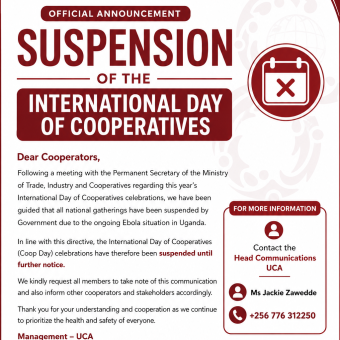
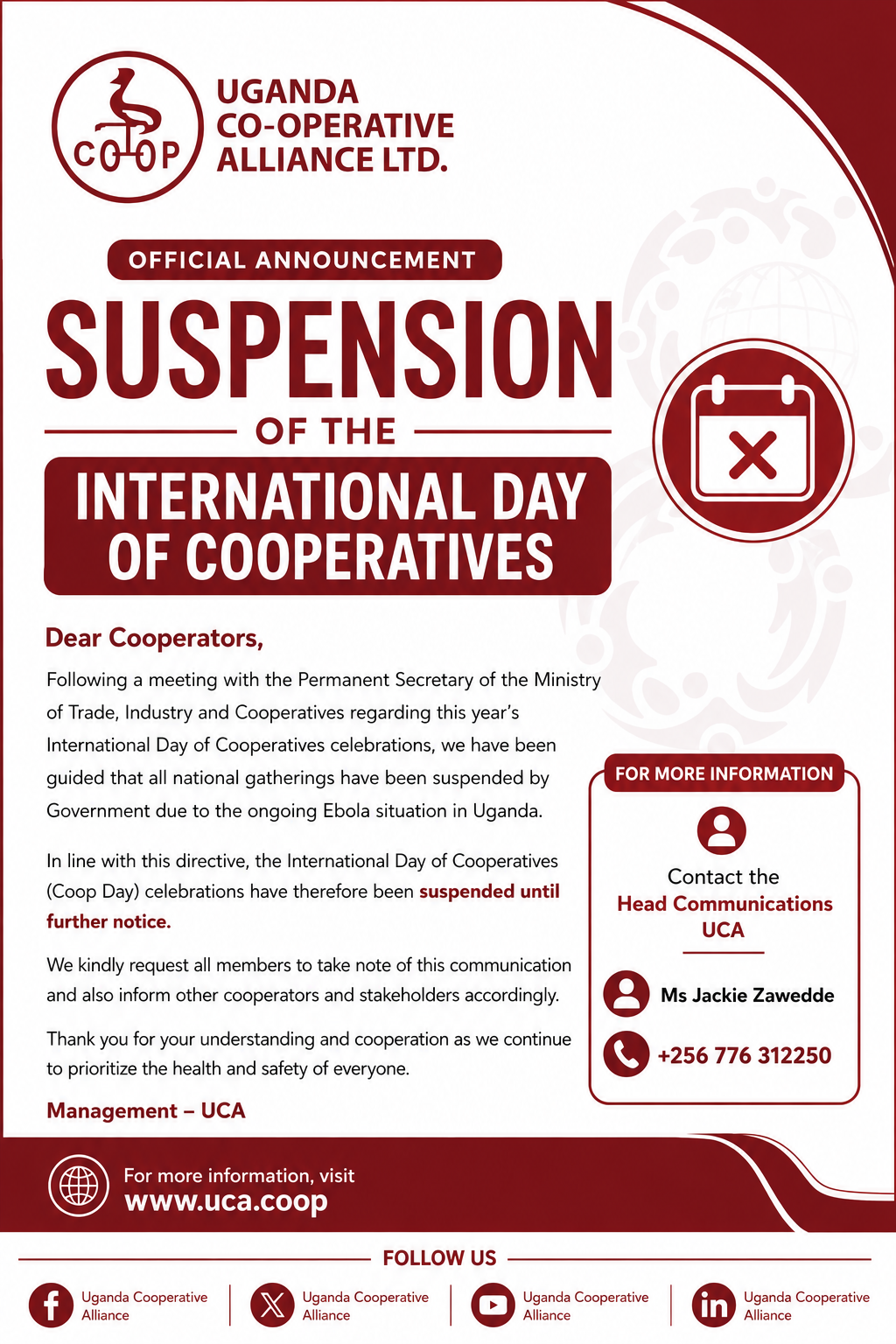
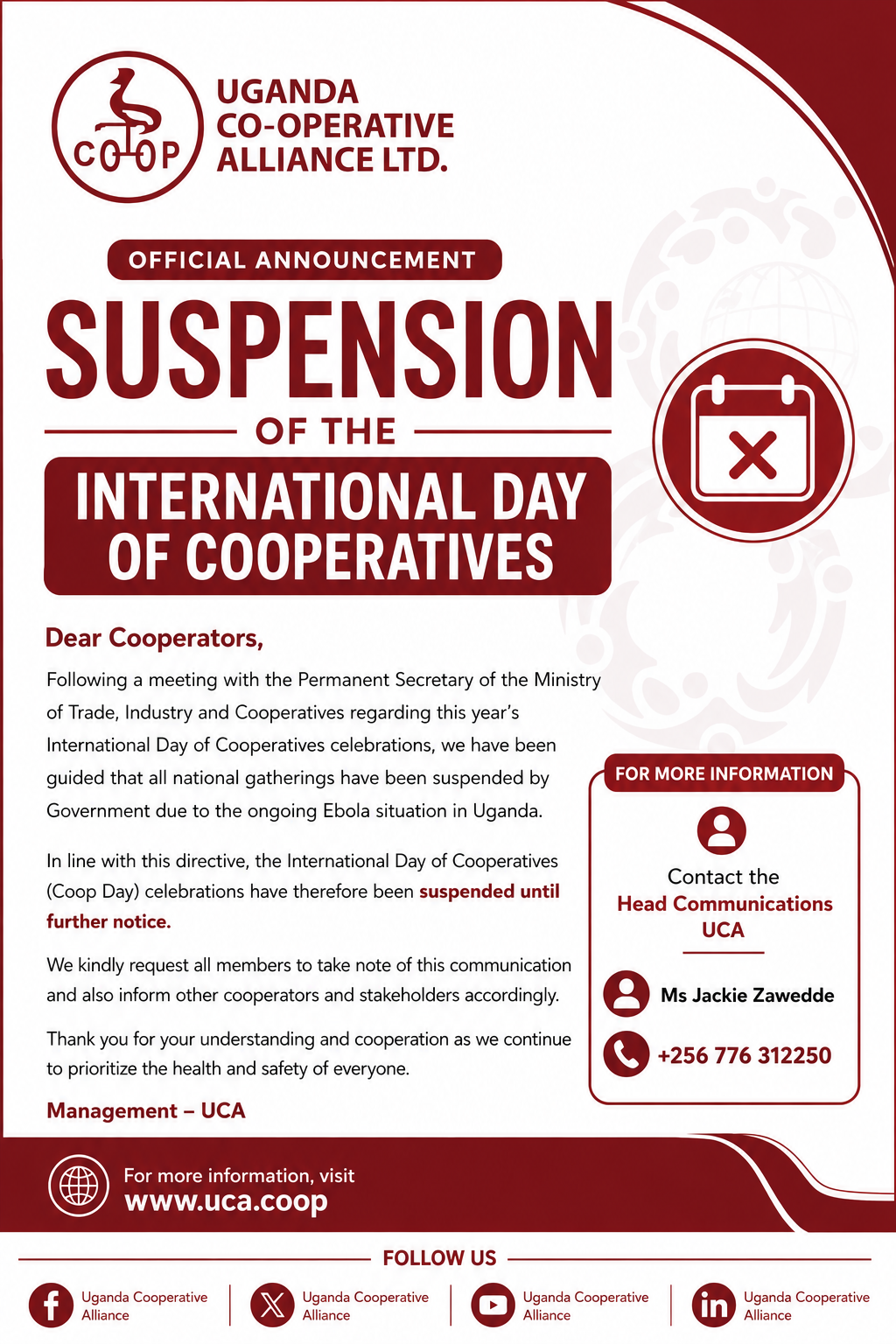
STATEMENT ON THE SUSPENSION OF THE INTERNATIONAL DAY OF COOPERATIVES CELEBRATIONS
22nd May 2026, Kampala: Uganda Cooperative Alliance together with the Organizing Committee for this year’s International Day of Cooperatives wish to inform all cooperators, partners, stakeholders, and the general public that the planned national celebrations have been suspended until further notice.
This decision follows guidance issued during a meeting with the Permanent Secretary of the Ministry of Trade, Industry and Cooperatives, in line with the Government of Uganda’s directive regarding the temporary suspension of national gatherings as the country continues to monitor and manage the Ebola situation.
Government has taken these precautionary measures in the interest of safeguarding public health and ensuring the safety and well-being of all Ugandans. While the current situation should not cause panic or unnecessary alarm, it calls for collective responsibility, vigilance, and adherence to the guidance provided by the relevant authorities and health agencies.
As the cooperative movement, we remain committed to supporting national efforts aimed at protecting communities while continuing to uphold the values of solidarity, care, and shared responsibility that define cooperatives worldwide.
We would also like to assure all cooperators and partners that discussions are underway to explore alternative avenues through which this year’s celebrations may still be commemorated. These may include virtual engagements, digital campaigns, media activities, or other innovative approaches that will allow members of the cooperative movement to participate safely.
We shall continue to provide updates as more guidance becomes available.
We thank all cooperators and stakeholders for their understanding, patience, and continued cooperation.
For further information,
Contact
Ms. Jacqueline Zawedde
Head of Communications and Marketing
Uganda Cooperative Alliance
0776312250 or This email address is being protected from spambots. You need JavaScript enabled to view it.